The Folded Footbridge
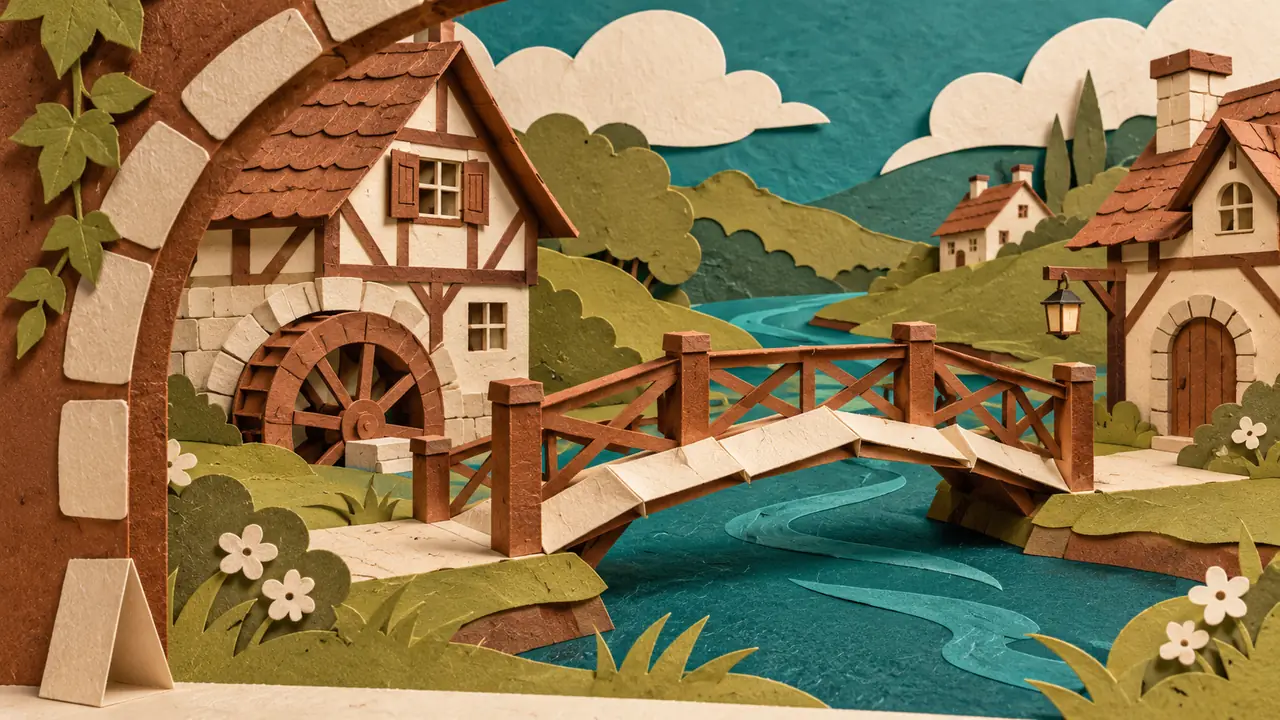
The river in The Folded Footbridge runs between two cardstock banks. A thin front span reaches a support in the middle. Behind it a second piece folds up far enough to show a small writing mark on its back. The traveler needs to decide which piece they can lift now, which can carry a crossing and where they will have to return later to read the rest of the story.
Keep a footpath while you lift a page
The loop begins by walking along a firm bank, inspecting a fold and moving one piece of the bridge. The front piece stops just over the support. Its triangular fold spreads the paper load across a second layer below it. If both are lifted, the traveler can see the river and the first note but cannot walk straight across. Lower one piece and you can reach a stable ledge at the middle before lifting the other farther.
At first the open bridge was as usable as the closed one. That let the traveler inspect the paper from any position without changing the route. The current prototype uses the position of the flap to decide where a foot can rest. The bridge stays in the last configuration when you walk away. From the near side you can choose a route to the far bank or keep one hidden surface open for inspection.
Use folds and shadows to read the structure
Cream card edges show which paper bears a step. Brown spans cast a short shadow on the teal river. The fold underneath is made from more muted paper, with a crease that catches just enough light to describe its direction. As you approach a hinge from either bank, the cut around the tab is visible beside the corner of the footbridge. It signals the part that moves without removing the surface from view.
Sound comes from paper movement and a quiet river underneath. Lifting a sheet produces a short dry snap as it settles. When the traveler reaches a stable spot, the sound of the river remains light enough to leave space for that change. On the ledge near the middle, the angle of the fold is visible without needing a sound cue. You can inspect its contact with the support before attempting the next step.
Read the hand that used the far side
On the reverse is part of a traveler’s mark with a line pointing to the stone nearest the river. The other part can be read from the far bank if you leave one flap at a useful angle. The prototype lets you return to the middle and check which surface still needs a path. The mark explains one visit to this spot in the fictional village. It does not tell the current traveler which angle to choose.
The Folded Footbridge is in prototype development. The current exercise tests the short span, one useful landing and the paper note that can be read from both sides. The folded support note follows the first step. The reverse tale note records how the traveler can lower the flap and retain the story reference. The paper back index links the result to the other scene.