Village Behind the Verge
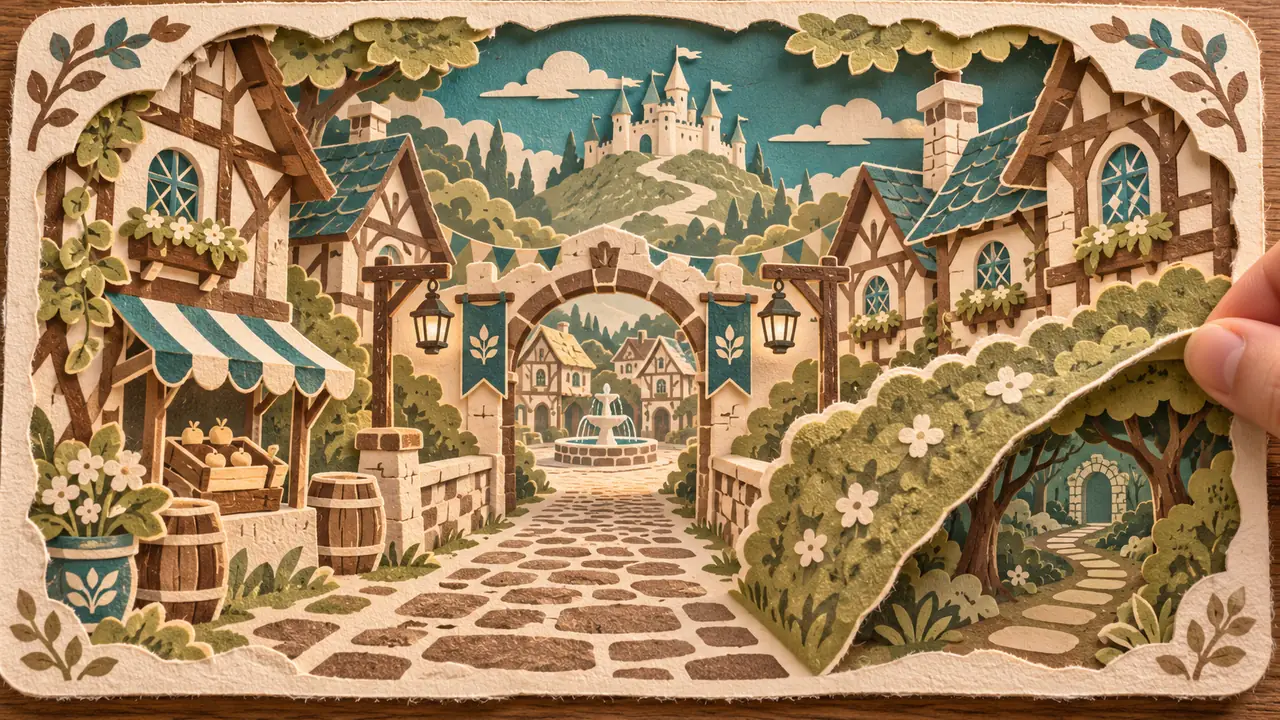
Seen from the first street, a tall paper hedge seems to reach all the way to the corner of a house. Its bottom ends just before a narrow lane. The traveler finds the lane by lifting a tab cut along the edge of the leaves. The upper part of the village remains where it was, while a section between the foreground and the next sheet becomes possible to explore.
Lift one sheet far enough to try the path
The first decision is how far to move the hedge. A small turn allows the traveler to see the beginning of a stepped path at the back. More movement clears the narrowest point near the house. The hinge remains fixed at its base. The player can look at the gap, follow it to the first bend and return to the original place before changing its angle again.
The loop begins by noticing a cut edge, moving one layer and seeing what the new view makes possible. The player then walks through part of the space and finds a reference that will remain after the foreground comes back down. One house has a paper window shaded with a simpler color on the back. That shade lets the traveler connect the view from the lane to the shape they saw on the main street.
Follow a window through two versions of the street
From the lane, the thin frame sits above the traveler and casts a shadow on the second paper strip. The foreground can be lowered away from this position. The path does not disappear from the set, but a route back to the main street is temporarily hidden. Look for the window outline and examine which way the shadow falls. It leads to a shallow turn where a second opening comes into view.
We use warm cream paper fibers, brown roof edges and a small teal strip where a track is entirely clear to the traveler. A hinge should remain recognizable under soft light. The same edge shows the shape of the path before the movement and gives a clear reference when the sheet stops. A quiet sound of paper under tension helps distinguish a crease that is still moving from a tab at rest.
Reopen a familiar layer with a new question
When the lane is uncovered again the traveler can see marks where somebody stopped to write on the back of the hedge. The marks supply a story in small pieces. They can be read from more than one position and leave a good reason to connect the lanes. The traveler needs enough room to get close to the right part of the sheet, so the action of reading still changes how they use the path.
This storybook concept is in prototype development. Our current exercise is a single corner, two windows and one foreground lift. Read the hinge study for the point where the path becomes visible and the window note for how a reader reconnects the two views. The street layer index returns to the other ways through the set.